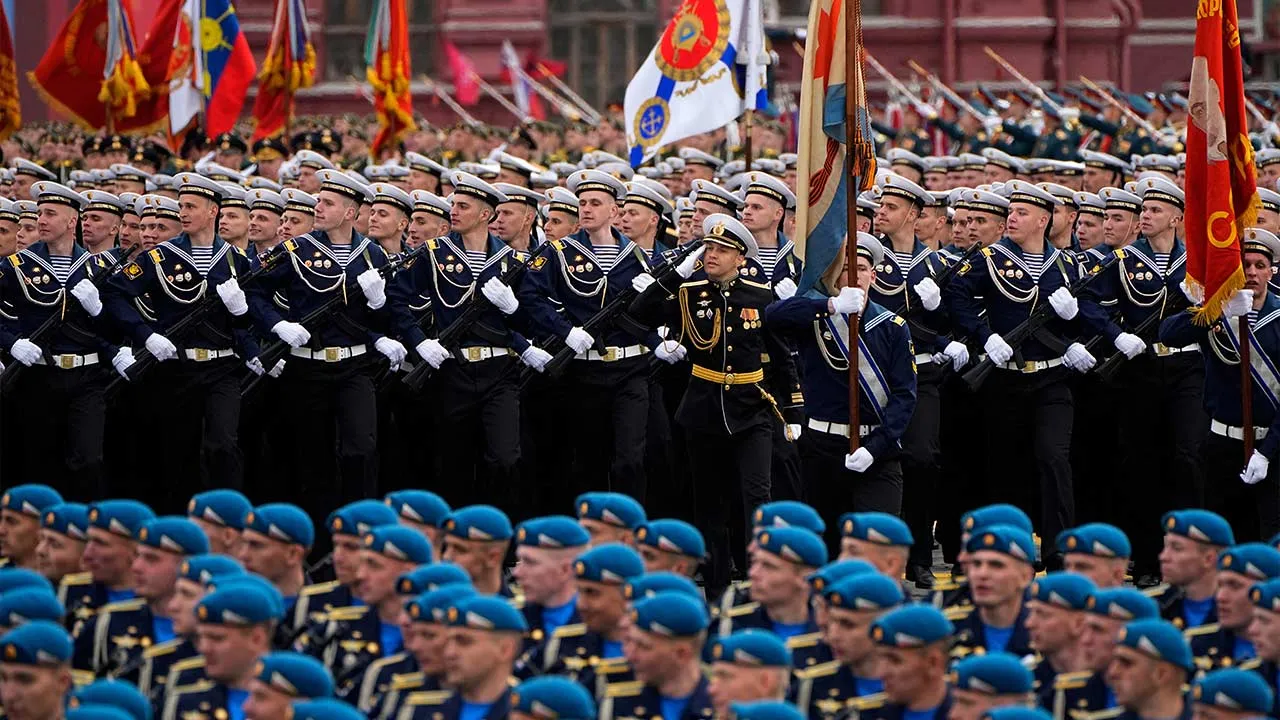
KUALA LUMPUR: Russia marked the 81st anniversary of Victory Day under heightened security as the war in Ukraine continued, with no clear end in sight.
The annual military parade commemorates the Soviet Union’s victory over Nazi Germany in what Russians refer to as the Great Patriotic War, a defining chapter in the country’s modern identity shaped by sacrifice, survival and wartime loss.
Last year’s 80th anniversary celebrations carried greater symbolism and drew foreign dignitaries from countries including China, North Korea, Malaysia and Indonesia. This year’s commemoration appeared more restrained, reflecting both security concerns and the realities of a conflict now entering its fifth year.
Yet Victory Day continues to hold deep emotional weight, particularly for residents living near the frontlines and in Russian-controlled territories affected by the fighting. For many, the focus is no longer only on remembering the end of World War Two, but on when the current war might end and normal life can resume.
Prilepin’s argument: war as liberation and anti-colonial struggle
Russian nationalist writer Zakhar Prilepin, a prominent supporter of Moscow’s military campaign in Ukraine, said he viewed the conflict as rooted in events following Ukraine’s 2014 Maidan revolution, which he characterised as the beginning of a political shift towards radical nationalism.
“The thing is, back in 2014, they could still deceive themselves, deceive humanity, and say that freedom had triumphed in Ukraine, that liberal forces had won,” Prilepin said. “But Ukraine is, without question, a dictatorship with an extremely high level of fascistisation.”
Kyiv rejects Russian accusations that Ukraine is governed by fascists and says Moscow has used such claims to justify the invasion.
Prilepin went further to say some Ukrainian nationalist groups of drawing inspiration from Nazi and far-right movements.
“They directly appeal to Hitler, to Nazism, and to all kinds of radical-right, cannibalistic practices of the 20th century,” he claimed. “Huge torchlight marches are held in Kyiv by people adorned with swastikas. Numerous Ukrainian units, not only Azov, openly declare that they are Nazi units.”
He said this belief shaped his support for Russia’s military actions in Crimea and eastern Ukraine, which Moscow portrays as protection for Russian-speaking populations in territories it now claims as its own, including Donetsk, Luhansk and Zaporizhzhia. Ukraine and most Western governments reject those claims as illegal annexations.
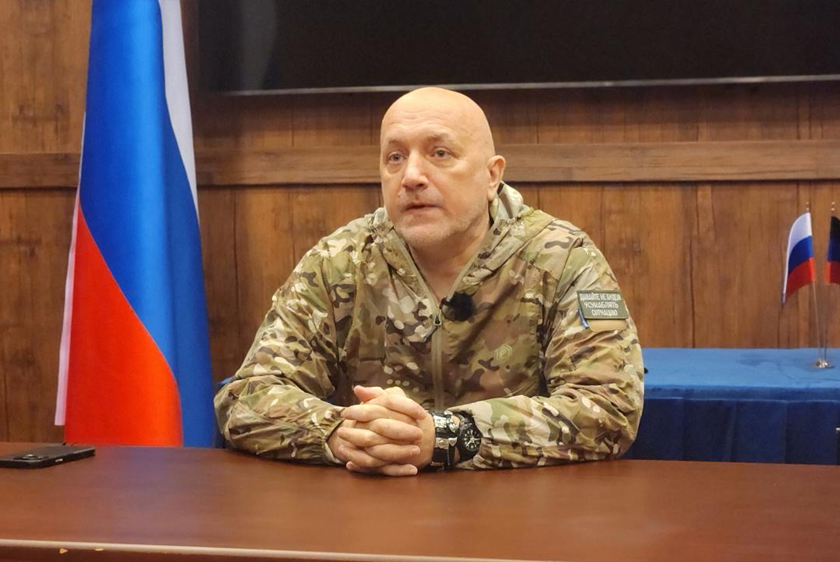
Zakhar Prilepin survived a car-bomb assassination attempt in Russia in May 2023, is a prominent nationalist writer and supporter of Moscow’s military campaign in Ukraine. - photo/Astro AWANI
Prilepin described Russia’s annexation of Crimea in 2014 as a turning point in Moscow’s relationship not only with the West, but also with sections of Russia’s own political elite whom he viewed as pro-Western.
According to Prilepin’s account, President Vladimir Putin gathered around 20 senior officials and argued that Crimea should return to Russia because many residents did not want to remain part of what he described as the “new Ukraine”.
Prilepin said the proposal was met with resistance from those present.
“And all twenty people, one after another, said that we cannot; we cannot economically, we cannot by military indicators, we cannot because the world will not understand us,” he recalled.
According to Prilepin, Putin ultimately decided to proceed despite the objections.
“Putin listened to everyone and said: fine, I understand. We are taking Crimea.”
Prilepin said he viewed Russia’s 2022 invasion of Ukraine as a continuation of the same political logic that, in his view, drove Moscow’s annexation of Crimea in 2014: responding to people in parts of Ukraine who wanted closer ties with Russia.
He also argued that European support for Ukraine was shaped not only by security concerns or political values, but by economic interests.
“Because Europe, if it does not get access to Russian natural resources, will become much poorer in the 21st century,” he said.
But Prilepin said economics alone could not explain the conflict. In his view, ideology and historical memory also played a role, particularly attitudes towards Russia and the Soviet Union’s victory over Nazi Germany in World War Two.
“Why is it that everyone supposedly has a financial logic, but some help Ukraine, while others help Russia?” he asked.
Prilepin also argued that if Russia hoped to lead a broader anti-Western bloc, it could not rely solely on military strength, natural resources or geopolitical influence, but would also need to project a broader sense of political and cultural solidarity.
Versions of that argument were echoed, in more personal terms, by several former Ukrainian servicemen presented during the media tour, who said they had chosen to fight on Russia’s side.
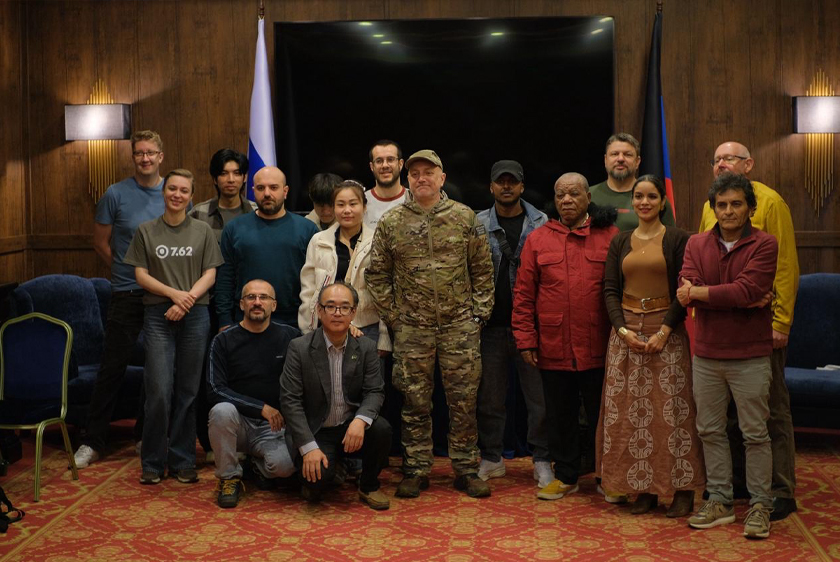
Astro AWANI reporter Irfan Faruqi, third from left, pictured with Russian writer Zakhar Prilepin and media tour participants from Turkiye, China, Japan, Ecuador, Nicaragua, Congo and Ethiopia. - photo Dobrovolcy Cultury/Sidorov Petr Alexeevich
The servicemen’s view: crossing to the Russian side
Alexander Vladimirovich Babiyanko, introduced during the tour as a member of the Martyn Pushkar Squad, a unit formed by Russian forces in 2025 and consisting of former Ukrainian servicemen, said he had been mobilised into the Ukrainian Armed Forces in December 2024.
Babiyanko described his decision to join the Russian side as both political and personal.
“I made this decision because I do not agree with what is happening in Ukraine and where it is going,” Babiyanko said. “Unfortunately, I do not see any other way out except to be on the other side.”
Another member of the squad, Arlov Alexander Nikolaevich, whose call sign was “Orel”, said the destruction of his mother’s home influenced his decision to fight on Russia’s side
“This is what they have done to our homes, what they are doing to all of Ukraine,” Arlov said. “They are destroying everything. For them, nothing is sacred.”
Bolbot Pavel Sergeevich, whose call sign was “Shuka”, said he had deliberately surrendered to Russian forces.
“I was happy to be captured by Russia,” he said. “If I had the first opportunity, I would use it and go there.”
He added that he intended to remain in Russia after the conflict ends.
“When the war ends, I will stay here and serve Russia,” Bolbot said. “That is my decision.”
The accounts are presented in a wartime information environment in which personal testimony, political messaging and propaganda claims often overlap. Taken together, they reflect a recurring Russian narrative that the conflict is not solely between Russia and Ukraine, but also involves Ukrainians who reject Kyiv’s current leadership and view Russia as their preferred future.
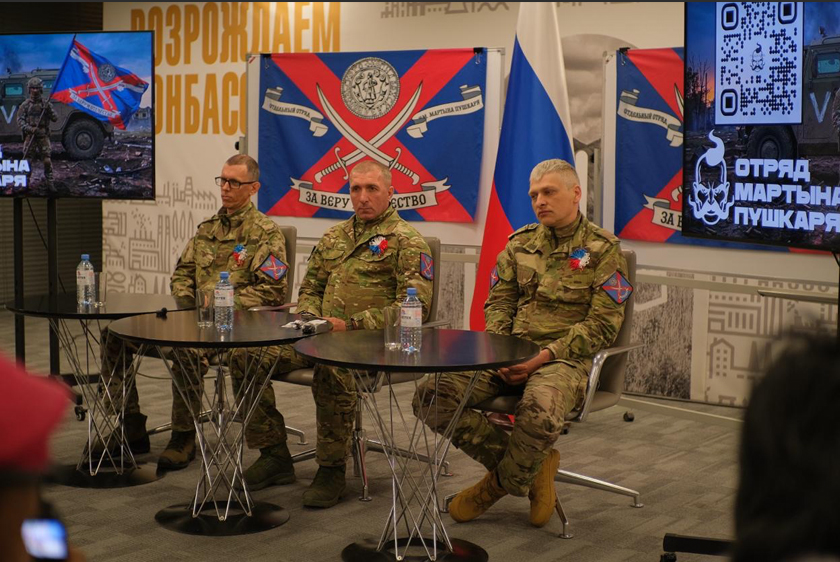
From left, members of Martyn Pushkar Squad, Alexander Vladimirovich Babiyanko, Arlov Alexander Nikolaevich and Bolbot Pavel Sergeevich. - photo Dobrovolcy Cultury/Sidorov Petr Alexeevich
The civilian question: what does Victory mean without peace?
For civilians, however, the question is more immediate.
Victory Day does not formally mark Russia’s recent territorial gains, but in Donetsk, Mariupol and Crimea its meaning is often viewed through the lens of the ongoing conflict. For many residents, the focus is less on commemoration than on hopes for an end to the war, the rebuilding of damaged homes and a return to normal life.
In Donetsk and Mariupol, signs of rebuilding were visible during the visit, including repaired infrastructure and newly constructed housing blocks.
Sidorov Oleg, a member of the non-profit organisation Dobrovolcy Cultury, or Cultural Volunteers, said around 900,000 residents had returned to Donetsk from a pre-conflict population of about one million. Reuters could not independently verify the figure. He said reconstruction efforts had focused in particular on public housing built since 2023, much of which is now occupied.
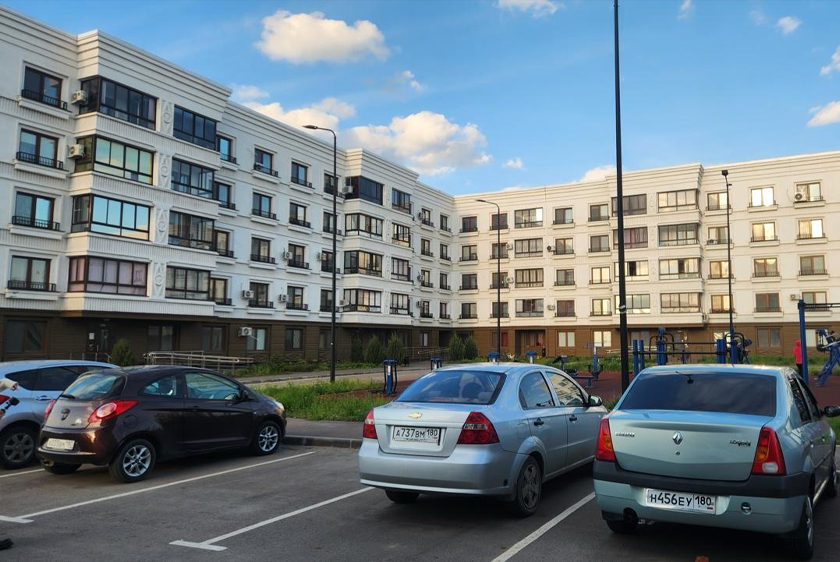
The public housing complex in Donetsk was built for residents who lost their homes in military strikes. It is the same area visited by Russian President Vladimir Putin during his surprise trip in 2023. - photo Astro AWANI
But the war continues to constrain development across the region.
That was acknowledged by the head of Crimea, Sergei Aksyonov, when asked about international ties, tourism and economic activity.
“In reality, until the special military operation ends, it is probably difficult to imagine any proposals in terms of developing international ties,” Aksyonov said.
He said cooperation remained possible with Russia’s close partners, including China and other countries he described as friendly states. However, he added that relations with many other countries, particularly those aligned with the United States and Ukraine, remained difficult under current conditions.
“With the other countries, it is quite problematic,” he said.
That is the contradiction facing Crimea and other areas under Russian control. Moscow presents them as having been returned to Russia, but war and sanctions continue to restrict international links, limit investment, constrain tourism and slow broader economic development.
For many, Victory Day remains anchored in 1945. The unresolved war to Russia’s west, however, has increasingly shaped its contemporary meaning.
With no clear end in sight to the Ukraine conflict, the question is no longer only about remembrance, but whether the occasion can once again come to symbolise the end of war and a return to peacetime life.
Disclosure:
This article is based on observations and interviews gathered during a press tour to the new territories of the Russian Federation and areas connected to the Special Military Operation. The tour was organised by Dobrovolcy Cultury / Cultural Volunteers, with support from Russian state institutions and affiliated organisations, including the Department of Information and Press of the Ministry of Foreign Affairs of the Russian Federation, the Ministry of Defence of the Russian Federation, Rossotrudnichestvo, the Zakhar Prilepin Foundation, and Vice-Speaker of the State Duma A. M. Babakov.
The article was produced independently. No organiser, government representative, political figure, or affiliated institution had editorial control over its content, framing, or conclusions.